
eVTOL Aircraft Energy Overhead Estimation under Conflict Resolution in High-Density Airspaces
↳ the Integrated Communications Navigation, and Surveillance (ICNS) Conference
// abstract
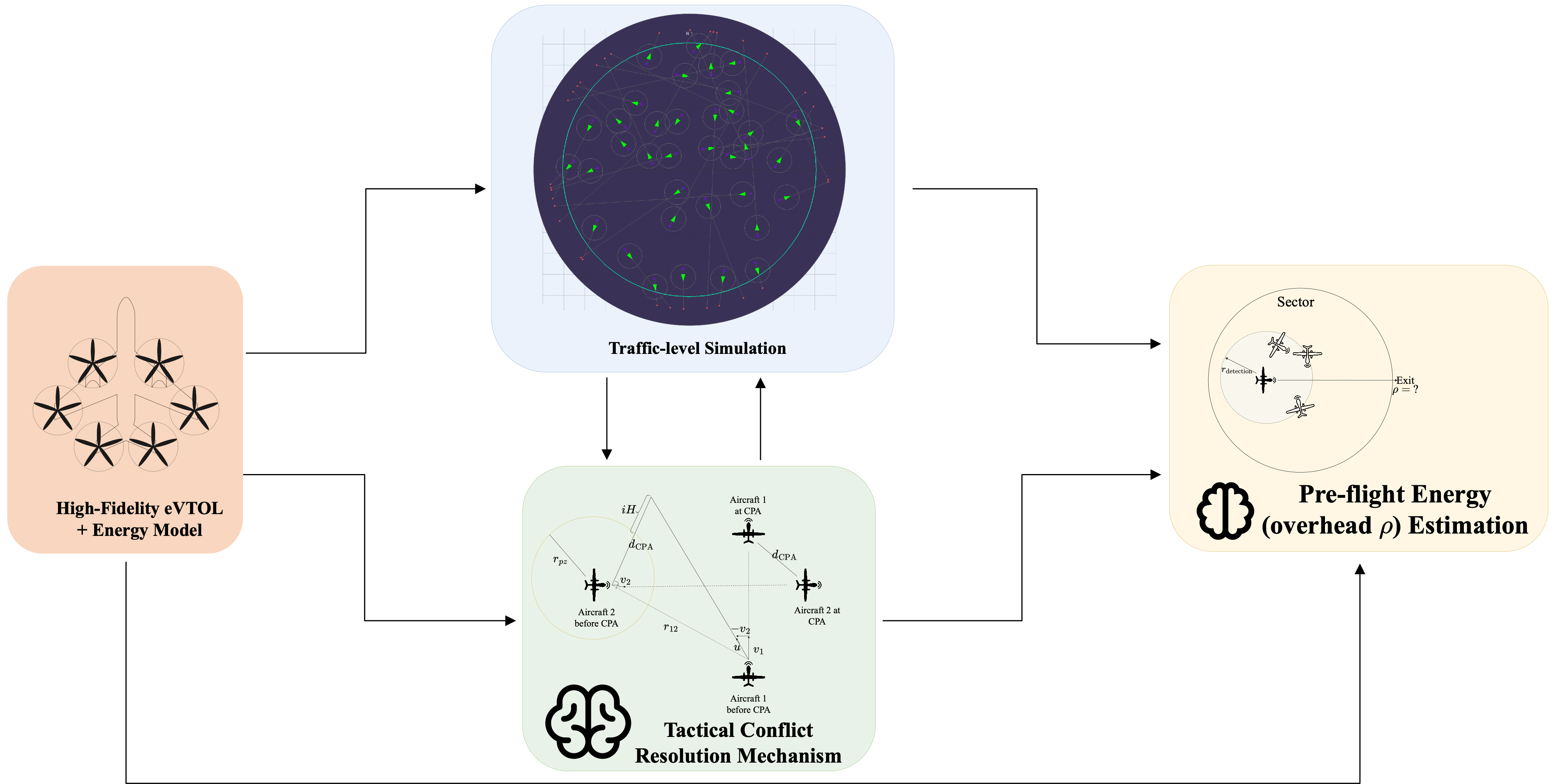
Electric vertical takeoff and landing (eVTOL) aircraft operating in high-density urban airspace must maintain safe separation through tactical conflict resolution, yet the energy cost of such maneuvers has not been systematically quantified. This paper investigates how conflict-resolution maneuvers under the Modified Voltage Potential (MVP) algorithm affect eVTOL energy consumption. Using a physics-based power model integrated within a traffic simulation, we analyze approximately 71,767 en route sections within a sector, across traffic densities of 10-60 simultaneous aircraft. The main finding is that MVP-based deconfliction is energy-efficient: median energy overhead remains below 1.5% across all density levels, and the majority of en route flights within the sector incur negligible penalty. However, the distribution exhibits pronounced right-skewness, with tail cases reaching 44% overhead at the highest densities due to sustained multi-aircraft conflicts. The 95th percentile ranges from 3.84% to 5.3%, suggesting that a 4-5% reserve margin accommodates the vast majority of tactical deconfliction scenarios. To support operational planning, we develop a machine learning model that estimates energy overhead at mission initiation. Because conflict outcomes depend on future traffic interactions that cannot be known in advance, the model provides both point estimates and uncertainty bounds. These bounds are conservative; actual outcomes fall within the predicted range more often than the stated confidence level, making them suitable for safety-critical reserve planning. Together, these results validate MVP's suitability for energy-constrained eVTOL operations and provide quantitative guidance for reserve energy determination in Advanced Air Mobility.
// highlights
- Quantifies the energy overhead of MVP-based tactical conflict resolution across ~71,767 en-route sections at densities of 10–60 aircraft.
- Median overhead stays below 1.5% across all densities, but the distribution is right-skewed with tail cases up to 44% under sustained multi-aircraft conflicts.
- The 95th-percentile overhead (3.84–5.3%) suggests a 4–5% reserve margin covers the vast majority of scenarios.
- A machine-learning model predicts overhead at mission start with conservative uncertainty bounds for safety-critical reserve planning.
// notes
This paper characterizes electric Vertical Take-off and Landing (eVTOL) aircraft energy consumption under an autonomous tactical conflict resolution framework (the Modified Voltage Potential or MVP) in an unstructured high-density airspace. It shows that the conflict resolution maneuvers in general do not significantly increase the energy consumption of eVTOLs, and that the energy overhead is more pronounced in scenarios with higher traffic density and more complex conflict situations. The findings suggest that the MVP framework can be an effective tool for managing air traffic while minimizing energy consumption, which is crucial for the sustainability of urban air mobility.
This manuscript was presented at ICNS 2026 (Best in-session paper award).
// bibtex
@misc{zongo2026evtol,
  title         = {eVTOL Aircraft Energy Overhead Estimation under Conflict Resolution
                   in High-Density Airspaces},
  author        = {Alex Zongo and Peng Wei},
  year          = {2026},
  eprint        = {2604.06093},
  archivePrefix = {arXiv}
}
// cite
Zongo, A., & Wei, P. (2026). "eVTOL Aircraft Energy Overhead Estimation under Conflict Resolution in High-Density Airspaces." arXiv preprint arXiv:2604.06093.